Section03_随机变量的独立性

概念和判定

  1. 定义 x,y\forall\ x,y,有 F(x,y)=FX(x)FY(y)F(x,y) = F_{X}(x)F_{Y}(y),即 P{Xx,Yy}=P{Xx}P{Yy}\mathbb{P}\{X\le x, Y\le y\} = \mathbb{P}\{X\le x\}\mathbb{P}\{Y\le y\} 称随机变量 X,YX,Y 独立
    • 直观上指 X,YX,Y 的取值互不影响
  2. 判定
    1. 离散型  i,j,P{X=xi,Y=yj}=P{X=xi}P{Y=yj}\forall\ i,j, \mathbb{P}\{X=x_{i},Y=y_{j}\} = \mathbb{P}\{X=x_{i}\}\mathbb{P}\{Y=y_{j}\},即 pij=pipjp_{ij}=p_{i\cdot}p_{\cdot j}
    2. 连续型 X,YX,Y 独立 \Leftrightarrow f(x,y)=fX(x)fY(y)f(x,y) = f_{X}(x)f_{Y}(y) 设二维随机变量 (X,Y)(X,Y) 的概率密度 f(x,y)={kg(x)h(y),axb,cyd0,其他f(x,y) = \begin{cases} kg(x)h(y), & a\le x\le b, c\le y\le d \\ 0, & \text{其他} \end{cases},即 x,yx,y 可分离,且区间为正矩形
  3. 结论
    1. X,YX,Y 独立,则 P{a<X<b,c<Y<d}=P{a<X<b}P{c<Y<d}\mathbb{P}\{a<X<b, c<Y<d\} = \mathbb{P}\{a<X<b\}\mathbb{P}\{c<Y<d\}
    2. X,YX,Y 独立,且 g(x),h(y)g(x),h(y) 连续,则 g(X),h(Y)g(X), h(Y) 仍然独立
      • X,YX,Y 独立 \substack{\rightarrow\\\nleftarrow} X2,Y2X^{2},Y^{2} 独立

例题

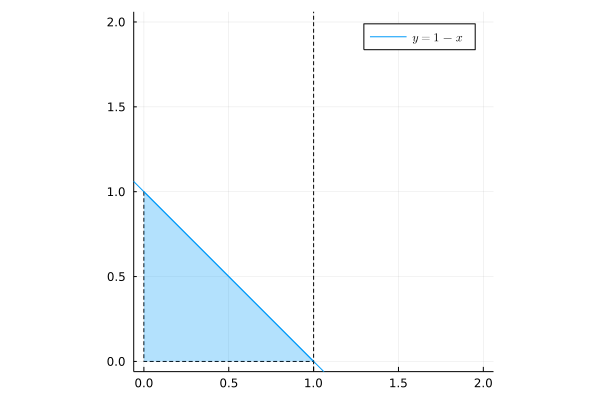
  1. 设随机变量 X,YX,Y 相互独立,且 XU(0,1); YE(1)X\sim U(0,1);\ Y\sim E(1),求 P{X+Y<1}\mathbb{P}\{X+Y<1\} X,Y相互独立,XU(0,1),YE(1)fX(x)={1,0<x<10,其他fY(y)={ey,y>00,y0f(x,y)={ey,0<x<1,y>00,其他P{X+Y<1}=x+y<1f(x,y)dσP{X+Y<1}=01dx01xf(x,y)dy=011ex1dx=(xex1)01=e1 \begin{array}{ll} \because & X,Y \text{相互独立}, X\sim U(0,1), Y\sim E(1) \\ \therefore & f_{X}(x) = \begin{cases} 1, & 0<x<1 \\ 0, & \text{其他} \end{cases} \\ & f_{Y}(y) = \begin{cases} e^{-y}, & y>0 \\ 0, & y \le 0 \end{cases} \\ \therefore & f(x,y) = \begin{cases} e^{-y}, & 0<x<1, y >0 \\ 0, & \text{其他} \end{cases} \\ \because & \displaystyle \mathbb{P}\{X+Y<1\} = \iint\limits_{x+y <1} f(x,y)\cdot d\sigma\\ \therefore & \displaystyle \mathbb{P}\{X+Y<1\} = \int_{0}^{1}dx \int_{0}^{1-x}f(x,y)\cdot dy \\ & \displaystyle = \int_{0}^{1} 1- e^{x-1}\cdot dx = (x - e^{x-1})\vert^{1}_{0} = e^{-1} \end{array}
    Trulli
    Fig.1 - 例1的积分范围

results matching ""

    No results matching ""